Overview
Sickle cell disease (SCD) is a group of inherited red blood cell disorders. Abnormal hemoglobin makes red blood cells hard, sticky, and sickle-shaped, so they die early and can get stuck in small blood vessels, causing pain, anemia, infection, and other serious complications.1,3,11
SCD affects about 100,000 people in the United States. It occurs in about 1 in 365 Black or African American births and about 1 in 16,300 Hispanic American births, and about 1 in 13 Black or African American babies is born with sickle cell trait.2 Worldwide, more than 300,000 babies are born with SCD each year.9 A person has SCD when they inherit two abnormal hemoglobin genes, one from each parent; the most common and usually most severe type, HbSS, is often called sickle cell anemia.1 People with sickle cell trait carry one copy of the gene, usually have no symptoms, and can pass the gene to their children.1,4 CDC estimates that life expectancy for people with SCD in the United States is more than 20 years shorter than average.2
Preparing for an appointment? Use the free visit worksheet to organize your notes and questions.
Common symptoms
- Sudden episodes of pain, often called pain crises, when sickled cells block blood flow to the chest, abdomen, joints, or bones.3,4
- Extreme tiredness or fussiness from anemia, and a yellowish color of the skin or the whites of the eyes (jaundice).4
- Painful swelling of the hands and feet in babies and young children; most babies have no problems from the disease before about 5 or 6 months of age.4
- Frequent or serious infections, because the disease can damage the spleen.3,4
- Serious complications such as acute chest syndrome, stroke, and organ damage over time.1,2
How it is diagnosed
In the United States, SCD is often found at birth through routine newborn screening.1 If a baby's screening results suggest SCD or sickle cell trait, further testing confirms the diagnosis.5
People who do not know whether they have sickle cell trait or disease can get a blood test that shows whether the body makes hemoglobin S, and genetic tests can show whether they carry one or two copies of the gene.5 Testing before birth can be done as early as 8 to 10 weeks into a pregnancy.5
Typical treatment approaches
Care is usually planned with a hematologist and aims to prevent complications as well as treat symptoms.6,7 Daily penicillin for young children, recommended vaccines, and regular stroke screening with transcranial Doppler ultrasound for children with the more severe types are core parts of preventive care.6,7 Hydroxyurea, a daily oral medicine, reduces pain crises, acute chest syndrome, and hospital stays, and is usually prescribed for infants as young as 9 months.6,7 Other FDA-approved medicines and blood transfusions are used for some people.6
Pain is managed with a plan that can include fluids, rest, and pain medicines, and severe pain may need hospital care.4,6,10 A blood and bone marrow transplant can cure SCD for some people with a well-matched donor, usually a close relative, and the FDA has approved gene therapies for certain patients aged 12 and older.6,8,10
Treatment decisions depend on each person’s history, examination, and other conditions, and should be made with a qualified clinician.
What current evidence indicates
- In December 2023, the FDA approved the first two cell-based gene therapies for SCD in people aged 12 and older, including the first approved treatment to use a genome-editing technology.8
- NHLBI reports that hydroxyurea can help people with SCD live longer, and that some children at higher risk of stroke may use it in place of ongoing transfusions after a period of transfusion treatment.6
- CDC reports that many people with SCD do not receive the recommended healthcare screenings and treatments.2
What remains uncertain
It is not yet known whether hydroxyurea can prevent stroke in adults, and more studies are needed on some of its long-term effects in children.6 Gene therapy and transplant are options only for certain patients, and researchers at NHLBI are still exploring other types of gene therapy.6
Useful details for a clinical visit
- Dates of recent pain episodes, where the pain was, and what helped
- Fevers, infections, hospital stays, and transfusions since your last visit
- Your sickle cell type, current medicines, and recent screening results
Using this guide before a visit
Write down the dates of pain episodes, fevers, or hospital visits since your last appointment and what treatment helped. Bring your current medicine list and any recent screening results, and ask which preventive checks are due now.
Tools that may help
BHI’s free tools can help you organize details like these before an appointment. They work in your browser, entries are not submitted to BHI, and they cannot assess symptoms.
- Symptom log: note each symptom or change and how strong it felt, then copy or print the list.
- Visit preparation worksheet: gather when symptoms began or changed, how they affect daily life, your medicines and supplements, and your questions for your clinician.
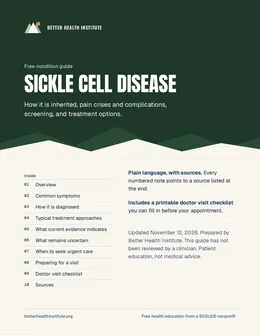
Free PDF · 10 pages · Includes a doctor visit checklist
Take the sickle cell disease guide to your next appointment
Print it before your visit or keep it on your phone. It opens as soon as you enter your email.
Questions to ask a clinician
- Which type of sickle cell disease do I or my child have, and what does that mean for care?
- Which screenings, such as stroke, eye, kidney, and lung checks, are due, and how often?
- Is hydroxyurea or another disease-modifying treatment right for me or my child?
- What is my plan for pain at home, and when should I go to the hospital?
When to seek urgent care
- Seek care from a clinician right away for a fever over 101.3°F (38.5°C); quick treatment with antibiotics may be needed, and some people need to be hospitalized.4
- Go to the hospital for chest pain, coughing, fever, and shortness of breath, which can be signs of acute chest syndrome.4
- Call 911 for sudden weakness, numbness on one side of the body, confusion, or trouble speaking, seeing, or walking, which can be warning signs of a stroke.4
- An erection that lasts 4 hours or more is an emergency that needs hospital care.4
Sources
Sources checked: October 2026. Numbered references in the text link to the sources for those statements. Each source is labeled by type, such as government health information, clinical guideline, review, or original study.
- Government health information About Sickle Cell Disease — Centers for Disease Control and Prevention (CDC); accessed Nov 2026. www.cdc.gov/sickle-cell/about/index.html
- Government data summary Data and Statistics on Sickle Cell Disease — Centers for Disease Control and Prevention (CDC); accessed Nov 2026. www.cdc.gov/sickle-cell/data/index.html
- Government health information What Is Sickle Cell Disease? — National Heart, Lung, and Blood Institute (NHLBI), NIH; accessed Nov 2026. www.nhlbi.nih.gov/health/sickle-cell-disease
- Government health information Sickle Cell Disease: Symptoms — National Heart, Lung, and Blood Institute (NHLBI), NIH; accessed Nov 2026. www.nhlbi.nih.gov/health/sickle-cell-disease/symptoms
- Government health information Sickle Cell Disease: Diagnosis — National Heart, Lung, and Blood Institute (NHLBI), NIH; accessed Nov 2026. www.nhlbi.nih.gov/health/sickle-cell-disease/diagnosis
- Government health information Sickle Cell Disease: Treatment — National Heart, Lung, and Blood Institute (NHLBI), NIH; accessed Nov 2026. www.nhlbi.nih.gov/health/sickle-cell-disease/treatment
- Expert panel guideline summary Management of sickle cell disease: summary of the 2014 evidence-based report by expert panel members — JAMA (PubMed record); Sep 2014. pubmed.ncbi.nlm.nih.gov/25203083
- Government announcement FDA Approves First Gene Therapies to Treat Patients with Sickle Cell Disease — U.S. Food and Drug Administration (FDA); Dec 8, 2023. www.fda.gov/news-events/press-announcements/fda-approves-first-gene-therapies-treat-patients-sickle-cell-disease
- Patient organization Sickle Cell Disease Association of America — Sickle Cell Disease Association of America (SCDAA); accessed Nov 2026. www.sicklecelldisease.org
- Clinical guideline Sickle Cell Disease Guidelines — American Society of Hematology (ASH); accessed Nov 2026. www.hematology.org/education/clinicians/guidelines-and-quality-care/clinical-practice-guidelines/sickle-cell-disease-guidelines
- Government health information Sickle Cell Disease — MedlinePlus, National Library of Medicine (NIH); accessed Nov 2026. medlineplus.gov/sicklecelldisease.html