Overview
Polycystic ovary syndrome (PCOS) is a common hormonal condition in which higher-than-usual androgen levels and other hormone imbalances can cause irregular or missed periods, extra facial or body hair, acne, and trouble getting pregnant.1,2 It is estimated to affect 10 to 13% of women of reproductive age, and up to 70% of those affected may not know they have it.1
PCOS can start in the teen years but is often recognized only when someone has trouble becoming pregnant.1,2 It runs in families, and it is more than a reproductive condition: it is linked to insulin resistance, type 2 diabetes, and other long-term health risks that continue after the reproductive years.1,5 Despite the name, not everyone with PCOS has cysts or follicle growths on the ovaries.2 The U.S. National Institute of Child Health and Human Development notes that PCOS is also known as polyendocrine metabolic ovary syndrome (PMOS).2
Preparing for an appointment? Use the free visit worksheet to organize your notes and questions.
Common symptoms
- Irregular, infrequent, or absent periods, or for some people heavy, long, or painful periods.1,3
- Extra hair on the face, chest, or back, a thinning scalp, oily skin, or acne.1,2
- Difficulty getting pregnant because ovulation does not happen regularly.1,2
- Dark, thick patches of skin, often on the neck, armpits, or groin, which can be a sign of insulin resistance.2,3,7
- Weight changes, and higher rates of depression and anxiety.3,4,7
How it is diagnosed
There is no single test for PCOS. In adults, the 2023 international guideline uses two of three features: irregular or absent ovulation, signs or blood tests showing high androgens, and polycystic ovaries on ultrasound or a high AMH level, after other causes have been ruled out.4,2
Clinicians usually check for conditions that can look similar, such as thyroid disease, high prolactin levels, and adrenal conditions.3,4 In teenagers, both irregular cycles and high androgens are needed, and ultrasound is not recommended for diagnosis within eight years of the first period.4
Typical treatment approaches
Treatment depends on symptoms and goals. Healthy eating, physical activity, and good sleep support metabolic health at any weight.4,6 For irregular periods, extra hair, or acne, combined hormonal birth control is commonly used, and anti-androgen medicines or hair-removal methods may be added.1,3,4
A medicine that helps the body use insulin may be used for metabolic features.3,4 For people trying to conceive, medicines that trigger ovulation are usually tried first, followed by other fertility treatments such as IVF when needed.1,4 Because PCOS raises long-term risks, guidelines recommend regular checks of blood sugar, blood pressure, and cholesterol, along with mental health screening.4,5
Treatment decisions depend on each person’s history, examination, and other conditions, and should be made with a qualified clinician.
What current evidence indicates
- The 2023 international evidence-based guideline allows a blood test for anti-Müllerian hormone (AMH) as an alternative to ultrasound when diagnosing PCOS in adults.4
- The same guideline treats PCOS as a lifelong condition with metabolic, reproductive, and mental health effects, and recommends screening for depression, anxiety, and eating disorders.4
- Genetic research suggests there may be two or more subtypes of PCOS, defined by different sets of genes.2
What remains uncertain
The exact cause of PCOS is unknown, though a family history of PCOS or type 2 diabetes raises the risk.1 Researchers are still working out how genetic subtypes relate to symptoms and long-term health.2,4
Useful details for a clinical visit
- Dates of your recent periods, including long gaps or unusually heavy bleeding
- Changes in hair, skin, or weight, and when they started
- Family history of PCOS or diabetes, current medicines, and any pregnancy plans
Using this guide before a visit
List the start dates of your last several periods, or note that they have stopped, and add any recent blood test results you already have. Choose the symptom that bothers you most and ask how treatment would fit your plans, including whether you hope to become pregnant.
Tools that may help
BHI’s free tools can help you organize details like these before an appointment. They work in your browser, entries are not submitted to BHI, and they cannot assess symptoms.
- Symptom log: note each symptom or change and how strong it felt, then copy or print the list.
- Visit preparation worksheet: gather when symptoms began or changed, how they affect daily life, your medicines and supplements, and your questions for your clinician.
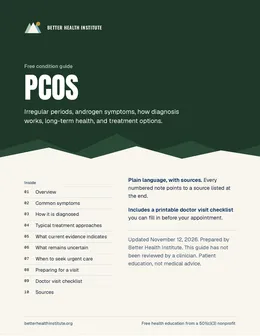
Free PDF · 10 pages · Includes a doctor visit checklist
Take the PCOS guide to your next appointment
Print it before your visit or keep it on your phone. It opens as soon as you enter your email.
Questions to ask a clinician
- Which tests are needed to confirm PCOS and rule out other causes?
- Which treatment fits my main concern right now: periods, skin and hair, or fertility?
- How often should my blood sugar, blood pressure, and cholesterol be checked?
- Should I be screened for sleep apnea, depression, or anxiety?
When to seek urgent care
- Get medical help right away or call 911 for sudden, sharp pain in the abdomen, a belly that is hard and tender to the touch, or pain while pregnant or possibly pregnant.9,11
- Contact a clinician promptly for bleeding that soaks through one or more pads or tampons every hour for several hours in a row, or a period lasting more than 7 days.10
- If you have thoughts of harming yourself, call or text 988 to reach the Suicide and Crisis Lifeline, or call 911 if you are in immediate danger.8
Sources
Sources checked: October 2026. Numbered references in the text link to the sources for those statements. Each source is labeled by type, such as government health information, clinical guideline, review, or original study.
- International health agency fact sheet Polycystic ovary syndrome (fact sheet) — World Health Organization (WHO); accessed Nov 2026. www.who.int/news-room/fact-sheets/detail/polycystic-ovary-syndrome
- Government health information About Polycystic Ovary Syndrome (PCOS) — Eunice Kennedy Shriver National Institute of Child Health and Human Development (NICHD), NIH; accessed Nov 2026. www.nichd.nih.gov/health/topics/pcos/conditioninfo
- Professional society patient education Polycystic Ovary Syndrome (PCOS) (FAQ) — American College of Obstetricians and Gynecologists (ACOG); accessed Nov 2026. www.acog.org/womens-health/faqs/polycystic-ovary-syndrome-pcos
- Clinical guideline Recommendations From the 2023 International Evidence-based Guideline for the Assessment and Management of Polycystic Ovary Syndrome — Journal of Clinical Endocrinology and Metabolism (PubMed record); Sep 2023. pubmed.ncbi.nlm.nih.gov/37580314
- Government health information Diabetes and Polycystic Ovary Syndrome (PCOS) — Centers for Disease Control and Prevention (CDC); accessed Nov 2026. www.cdc.gov/diabetes/risk-factors/pcos-polycystic-ovary-syndrome.html
- Government health information Polycystic ovary syndrome — Office on Women's Health, U.S. Department of Health and Human Services; accessed Nov 2026. www.womenshealth.gov/a-z-topics/polycystic-ovary-syndrome
- Government health information Polycystic Ovary Syndrome — MedlinePlus, National Library of Medicine (NIH); accessed Nov 2026. medlineplus.gov/polycysticovarysyndrome.html
- Crisis service 988 Suicide and Crisis Lifeline — 988 Lifeline; accessed Nov 2026. 988lifeline.org
- Medical encyclopedia (NLM) Abdominal pain — MedlinePlus Medical Encyclopedia, National Library of Medicine; accessed Nov 2026. medlineplus.gov/ency/article/003120.htm
- Professional society patient education Heavy Menstrual Bleeding (FAQ) — American College of Obstetricians and Gynecologists (ACOG); accessed Nov 2026. www.acog.org/womens-health/faqs/heavy-menstrual-bleeding
- Medical encyclopedia (NLM) Recognizing medical emergencies — MedlinePlus Medical Encyclopedia, National Library of Medicine; accessed Nov 2026. medlineplus.gov/ency/article/001927.htm