Overview
Migraine is a common neurological condition that causes repeated attacks of moderate to severe headache, often throbbing and on one side of the head, usually with nausea or sensitivity to light and sound.1,3 Attacks usually last from 4 hours to 3 days, and migraine ranks among the leading causes of neurological disability worldwide.3
The American Migraine Foundation estimates that migraine affects 39 million people in the United States.2 Migraine often begins around puberty and is more common in women, likely because hormone changes such as the menstrual cycle and pregnancy can trigger attacks.1,3 Triggers differ from person to person and can include too much or too little sleep, stress, skipped meals, alcohol, strong smells, bright lights, and changes in weather.1 Between attacks, some people have trouble concentrating, fatigue, or poor sleep.1
Preparing for an appointment? Use the free visit worksheet to organize your notes and questions.
Common symptoms
- Prodrome: hours to days before an attack, some people notice food cravings, mood changes, frequent yawning, or needing to urinate more often.1,2
- Aura, in some people: visual changes such as dots, zigzags, or sparks, or tingling or trouble speaking, usually lasting no more than an hour.1
- Headache phase: throbbing pain, often on one side, that worsens with routine activity, with nausea, vomiting, or sensitivity to light, sound, or smells.1,4
- Postdrome: exhaustion, confusion, dizziness, or trouble concentrating for up to two days after the pain ends.1
- Some people have migraine attacks with little or no headache, with vision changes, nausea, or other symptoms instead.1
How it is diagnosed
Migraine is diagnosed from your health history and a physical and neurological exam; no blood test or scan confirms it.1 International criteria for migraine without aura require at least five attacks lasting 4 to 72 hours, with typical headache features and either nausea or sensitivity to both light and sound, not better explained by another diagnosis.4
Brain imaging such as MRI or CT is not usually needed, but a clinician may order it if another cause is suspected.1,8 Chronic migraine means migraine headaches on at least 15 days a month for more than three months.1 A headache diary that records timing, severity, medicines taken, sleep, and possible triggers can help with diagnosis and planning.1
Typical treatment approaches
Treatment has two parts: acute medicines taken as soon as an attack begins, and preventive treatment for people with frequent or disabling attacks.1,5 Acute options range from over-the-counter pain relievers to migraine-specific prescription medicines and anti-nausea medicines.1,5 Resting in a quiet, dark room, a cool cloth on the forehead, and fluids can also help.1,7
Preventive options include some medicines first used for blood pressure, seizures, or depression, newer medicines that block CGRP, and, for chronic migraine, botulinum toxin injections.1,6 Taking acute headache medicines too often can lead to medication-overuse headache, the most common secondary headache disorder, so it helps to track how many days a month you take them.3,8
Treatment decisions depend on each person’s history, examination, and other conditions, and should be made with a qualified clinician.
What current evidence indicates
- In 2024 the American Headache Society stated that therapies targeting CGRP, a protein involved in migraine pain, are a first-line option for preventing migraine.6
- Worldwide, only a minority of people with headache disorders are appropriately diagnosed and treated by a health care provider.3
- People with migraine more often have depression, anxiety, and sleep disorders, and conditions such as epilepsy are also more common among them.1
What remains uncertain
The exact cause of migraine is not known; current research points to problems in nerve signals, brain chemicals, and blood vessels in the brain.1,3 Scientists are still studying how to predict attacks and how conditions such as sleep disturbance and depression affect migraine.1
Useful details for a clinical visit
- How many headache days you have a month, and how long attacks last
- Aura, nausea, or other symptoms that come with attacks
- Every medicine you use for attacks and how many days a month you take it
Using this guide before a visit
Keep a simple headache diary for a few weeks if you can: dates, how long each attack lasted, what you took, and what you missed because of it. Bring your monthly totals for headache days and medicine days, and ask whether your pattern points to preventive treatment.
Tools that may help
BHI’s free tools can help you organize details like these before an appointment. They work in your browser, entries are not submitted to BHI, and they cannot assess symptoms.
- Symptom log: note each symptom or change and how strong it felt, then copy or print the list.
- Visit preparation worksheet: gather when symptoms began or changed, how they affect daily life, your medicines and supplements, and your questions for your clinician.
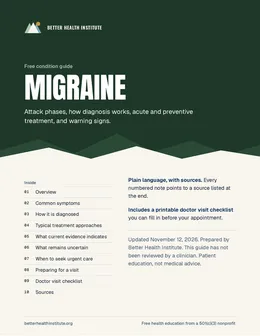
Free PDF · 10 pages · Includes a doctor visit checklist
Take the migraine guide to your next appointment
Print it before your visit or keep it on your phone. It opens as soon as you enter your email.
Questions to ask a clinician
- Do my headaches fit migraine, or should another type of headache be considered?
- Which acute treatment should I try first, and what should I do if it does not work?
- Am I a candidate for preventive treatment, and how will we judge whether it helps?
- How many days a month can I safely use my headache medicines?
When to seek urgent care
- Call 911 or go to the nearest emergency room for a headache that comes on suddenly and is explosive or violent.8
- Call 911 immediately for possible signs of stroke: sudden drooping of one side of the face, sudden weakness or numbness in the face, arm, or leg (especially on one side), or sudden trouble speaking or understanding speech, even if you usually have aura.9,10
- Seek medical help right away for a headache that is the worst you have ever had, a headache with fever and a stiff neck, a headache after a head injury, or a headache with confusion, vision changes, or loss of balance.8
- Contact a clinician promptly if you start getting new headaches, especially after age 50, or if your headaches get worse over 24 hours.8
Sources
Sources checked: October 2026. Numbered references in the text link to the sources for those statements. Each source is labeled by type, such as government health information, clinical guideline, review, or original study.
- Government health information Migraine — National Institute of Neurological Disorders and Stroke (NINDS), NIH; accessed Nov 2026. www.ninds.nih.gov/health-information/disorders/migraine
- Patient organization What is Migraine? — American Migraine Foundation; accessed Nov 2026. americanmigrainefoundation.org/resource-library/what-is-migraine
- International health agency fact sheet Migraine and other headache disorders (fact sheet) — World Health Organization (WHO); Oct 24, 2025. www.who.int/news-room/fact-sheets/detail/headache-disorders
- Diagnostic criteria ICHD-3: 1.1 Migraine without aura — International Headache Society; accessed Nov 2026. ichd-3.org/1-migraine/1-1-migraine-without-aura
- Expert consensus The American Headache Society Consensus Statement: Update on integrating new migraine treatments into clinical practice — Headache (PubMed record); Jul 2021. pubmed.ncbi.nlm.nih.gov/34160823
- Position statement Calcitonin gene-related peptide-targeting therapies are a first-line option for the prevention of migraine: An American Headache Society position statement update — Headache (PubMed record); Apr 2024. pubmed.ncbi.nlm.nih.gov/38466028
- Government health information Migraine — MedlinePlus, National Library of Medicine (NIH); accessed Nov 2026. medlineplus.gov/migraine.html
- Medical encyclopedia (NLM) Headache — MedlinePlus Medical Encyclopedia, National Library of Medicine; accessed Nov 2026. medlineplus.gov/ency/article/003024.htm
- Government health information Stroke: Symptoms — National Heart, Lung, and Blood Institute (NHLBI), NIH; last updated May 26, 2023. www.nhlbi.nih.gov/health/stroke/symptoms
- Government health information Stroke (F.A.S.T. warning signs) — MedlinePlus, National Library of Medicine (NIH); accessed Nov 2026. medlineplus.gov/stroke.html