Overview
Endometriosis is a chronic condition in which tissue similar to the lining of the uterus grows outside the uterus, causing inflammation, pain, and sometimes scar tissue.1,4 It is estimated to affect about 1 in 10 women and girls of reproductive age.1,4
Endometriosis most often involves the ovaries, fallopian tubes, and other tissues in the pelvis, though it can also affect the bowel, bladder, and, rarely, organs outside the pelvis.1,6 It can begin with the first period and last until menopause, and it can also affect transgender men and nonbinary people who menstruate.1 Symptoms vary widely, and the size and location of the patches do not predict how severe the pain will be: some people with small patches have severe pain, while others with large patches have little.2 The time from first symptoms to diagnosis is often long, averaging 4 to 12 years worldwide.1
Preparing for an appointment? Use the free visit worksheet to organize your notes and questions.
Common symptoms
- Painful periods that may get worse over time, and pelvic pain that continues outside of periods.1,4
- Pain during or after sex.1,4
- Pain with bowel movements or urination, especially during a period.1,4
- Heavy menstrual bleeding, bloating, and nausea.1
- Trouble getting pregnant; endometriosis is a common cause of infertility.1,4
- Fatigue and effects on mental health, such as depression or anxiety.1,7
How it is diagnosed
There is no simple blood test for endometriosis. Diagnosis usually starts with a detailed history of periods and pain, a physical and pelvic exam, and imaging such as ultrasound or MRI, which can show larger areas such as cysts on the ovaries (endometriomas) or nodules.1,3,5
Imaging can miss small lesions and scar tissue, so a normal scan does not rule endometriosis out.3,5 Laparoscopy, a minimally invasive surgery, can confirm the diagnosis and remove tissue at the same time.3,4 A clinical diagnosis based on symptoms and imaging can also be enough to start treatment, without waiting for surgery.1,5
Typical treatment approaches
There is no cure, so treatment aims to relieve pain, protect fertility when that is a goal, and improve daily life.1 Options include pain relievers such as nonsteroidal anti-inflammatory drugs (NSAIDs) and hormonal treatments, such as combined hormonal contraceptives, progestins, and medicines that lower estrogen levels.1,4,5 Some hormonal options are not suitable for people who are trying to become pregnant.1
Surgery can remove endometriosis patches, cysts, and scar tissue, and may reduce pain or improve the chance of pregnancy for some people.1,4 Symptoms can come back after treatment, and removing the uterus is not a guaranteed cure.1 When infertility is a concern, fertility treatments such as IVF may be discussed.4,5
Treatment decisions depend on each person’s history, examination, and other conditions, and should be made with a qualified clinician.
What current evidence indicates
- European guidance from ESHRE (2022) no longer treats laparoscopy as the only way to diagnose endometriosis and recommends ultrasound or MRI as part of the first workup.5
- People with endometriosis have higher rates of other immune-related conditions, such as lupus, multiple sclerosis, and inflammatory bowel disease, and emerging research links endometriosis to immune system changes.1
- Researchers are developing less invasive tests, including blood, saliva, and menstrual-fluid tests, with the aim of shortening the delay in diagnosis.1,3
What remains uncertain
The causes of endometriosis are still unknown.1 Researchers do not know exactly what causes endometriosis pain, why symptoms persist or return in some people after treatment, or how to detect every form of the disease without surgery.1,2,3
Useful details for a clinical visit
- When pain occurs in your cycle, where you feel it, and how strong it is
- Pain with sex, bowel movements, or urination, and any change in bleeding
- Treatments already tried, how well they worked, and any pregnancy plans
Using this guide before a visit
For one or two cycles, note the days with pain or heavy bleeding and what you could not do on those days. Bring those notes and a list of treatments you have already tried, and ask which next step fits your goals, including any plans for pregnancy.
Tools that may help
BHI’s free tools can help you organize details like these before an appointment. They work in your browser, entries are not submitted to BHI, and they cannot assess symptoms.
- Symptom log: note each symptom or change and how strong it felt, then copy or print the list.
- Visit preparation worksheet: gather when symptoms began or changed, how they affect daily life, your medicines and supplements, and your questions for your clinician.
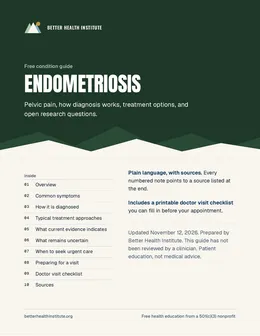
Free PDF · 10 pages · Includes a doctor visit checklist
Take the endometriosis guide to your next appointment
Print it before your visit or keep it on your phone. It opens as soon as you enter your email.
Questions to ask a clinician
- Could my symptoms be endometriosis, and what else should be considered?
- Would an ultrasound or MRI help, and what would a normal result mean?
- Which treatment options fit my goals, including whether I want to become pregnant?
- When would surgery or a referral to a specialist make sense?
When to seek urgent care
- Get medical help right away or call 911 for sudden, sharp pain in the abdomen, a belly that is hard and tender to the touch, vomiting blood, or trouble breathing.10,11
- If you could be pregnant and have sudden severe pain in the abdomen or pelvis, shoulder pain, weakness, dizziness, or fainting, seek emergency care; these can be signs of a ruptured ectopic pregnancy.8
- Contact a clinician promptly for bleeding that soaks through one or more pads or tampons every hour for several hours in a row, or for passing large clots.9
Sources
Sources checked: October 2026. Numbered references in the text link to the sources for those statements. Each source is labeled by type, such as government health information, clinical guideline, review, or original study.
- International health agency fact sheet Endometriosis (fact sheet) — World Health Organization (WHO); Oct 15, 2025. www.who.int/news-room/fact-sheets/detail/endometriosis
- Government health information About Endometriosis — Eunice Kennedy Shriver National Institute of Child Health and Human Development (NICHD), NIH; accessed Nov 2026. www.nichd.nih.gov/health/topics/endometri/conditioninfo
- Government health information How do healthcare providers diagnose endometriosis? — NICHD, NIH; accessed Nov 2026. www.nichd.nih.gov/health/topics/endometri/conditioninfo/diagnose
- Professional society patient education Endometriosis (FAQ) — American College of Obstetricians and Gynecologists (ACOG); accessed Nov 2026. www.acog.org/womens-health/faqs/endometriosis
- Clinical guideline ESHRE guideline: endometriosis — Human Reproduction Open (PubMed record); 2022. pubmed.ncbi.nlm.nih.gov/35350465
- Patient organization What is endometriosis? — Endometriosis Foundation of America; accessed Nov 2026. www.endofound.org/endometriosis
- Government health information Endometriosis — MedlinePlus, National Library of Medicine (NIH); accessed Nov 2026. medlineplus.gov/endometriosis.html
- Professional society patient education Ectopic Pregnancy (FAQ) — American College of Obstetricians and Gynecologists (ACOG); accessed Nov 2026. www.acog.org/womens-health/faqs/ectopic-pregnancy
- Professional society patient education Heavy Menstrual Bleeding (FAQ) — American College of Obstetricians and Gynecologists (ACOG); accessed Nov 2026. www.acog.org/womens-health/faqs/heavy-menstrual-bleeding
- Medical encyclopedia (NLM) Abdominal pain — MedlinePlus Medical Encyclopedia, National Library of Medicine; accessed Nov 2026. medlineplus.gov/ency/article/003120.htm
- Medical encyclopedia (NLM) Recognizing medical emergencies — MedlinePlus Medical Encyclopedia, National Library of Medicine; accessed Nov 2026. medlineplus.gov/ency/article/001927.htm